
Every business faces risks. Some risks are easy to predict, while others appear without warning. A sudden change in the market, a cybersecurity attack, financial problems, supply chain delays, or even an unexpected internal issue can affect a company’s performance. This is where Risk Management becomes important.
Risk management is the process of identifying potential threats, understanding their possible impact, and taking practical steps to reduce or control them. It does not mean eliminating every possible risk. Instead, it helps businesses prepare for uncertainty and make better decisions.
Whether you run a small business, manage a large organization, or work on individual projects, having a clear approach to risk can protect your resources, improve decision-making, and support long-term growth.
What Is Risk Management?
Risk management is a structured approach to dealing with uncertainty. It begins by identifying things that could go wrong and then evaluating how likely those events are and how seriously they could affect the organization.
For example, imagine a company depends heavily on one supplier. If that supplier suddenly stops operating, the company may struggle to deliver products to its customers. Recognizing this possibility allows the business to develop alternatives, such as working with additional suppliers or maintaining extra inventory.
Effective risk management combines planning, monitoring, communication, and action. It should not be treated as a one-time activity because risks can change as a business, industry, and economy change.
Why Is Risk Management Important?
Businesses cannot always predict what will happen in the future. However, they can prepare for different possibilities. A strong risk management strategy helps organizations become more resilient when unexpected situations occur.
One major benefit is better decision-making. When managers understand the risks associated with a particular decision, they can compare potential benefits with possible consequences.
Risk management can also protect financial resources. A company that identifies financial risks early may be able to reduce unnecessary expenses, improve cash flow planning, or establish emergency reserves.
Another important advantage is business continuity. If an organization has plans for common disruptions, it can respond faster when problems occur. This may reduce downtime and prevent a temporary issue from becoming a major crisis.
It can also improve customer and stakeholder confidence. People are more likely to trust organizations that demonstrate responsible planning and have clear procedures for handling problems.
Common Types of Business Risks
Risk can come from many different areas. Understanding the most common categories makes it easier to create an effective risk management plan.
Financial Risk
Financial risks involve money and financial stability. These may include cash flow problems, rising costs, unexpected expenses, interest rate changes, or customers failing to make payments.
Businesses can reduce financial risks through budgeting, financial forecasting, proper credit policies, insurance, and maintaining sufficient cash reserves.
Operational Risk
Operational risks are connected to the everyday activities of a business. Equipment failure, employee mistakes, poor processes, production problems, and system interruptions are common examples.
Improving internal procedures, training employees, maintaining equipment, and regularly reviewing business processes can help reduce these risks.
Cybersecurity and Technology Risk
Modern businesses depend heavily on technology, which creates another category of risk. Cyberattacks, data breaches, system failures, software vulnerabilities, and unauthorized access can cause serious damage.
Organizations should use appropriate security controls, regularly update software, protect sensitive information, train employees, and maintain reliable backups.
Strategic Risk
Strategic risks arise when business decisions do not produce the expected results. Launching the wrong product, entering an unsuitable market, failing to respond to competitors, or relying on an outdated business model can create strategic problems.
Businesses can manage these risks through market research, scenario planning, performance monitoring, and regular strategy reviews.
Compliance and Legal Risk
Companies must follow laws, regulations, contracts, and industry requirements. Failure to do so can result in penalties, lawsuits, financial losses, or reputational damage.
Keeping up with relevant requirements and maintaining appropriate policies can help organizations reduce compliance-related risks.
Reputational Risk
A company’s reputation can be damaged by poor customer service, unethical behavior, product problems, negative publicity, or security incidents.
Reputation is difficult to rebuild once trust has been lost. Businesses should therefore focus on transparency, ethical practices, customer satisfaction, and responsible communication.
The Risk Management Process
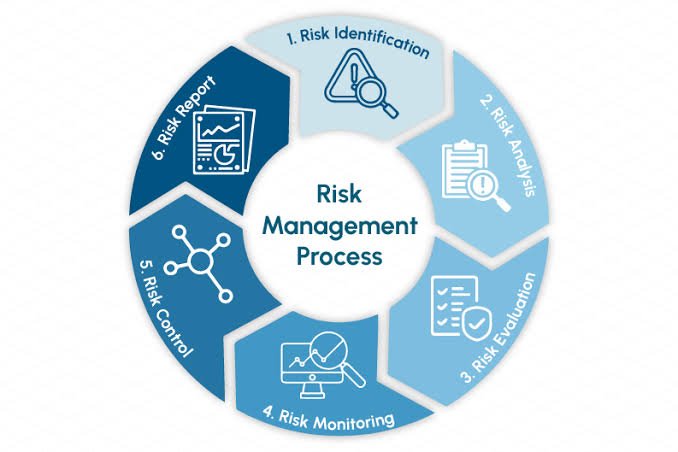
Although organizations may use different frameworks, the basic process usually follows several important steps.
1. Identify the Risks
The first step is to determine what could potentially harm the business. Teams can use brainstorming sessions, historical data, customer feedback, audits, industry research, and employee experience to identify risks.
It is useful to consider both internal and external sources. Internal risks may come from employees, processes, systems, or resources, while external risks can include economic changes, competitors, regulations, natural disasters, and market conditions.
2. Assess the Risks
After identifying risks, businesses need to evaluate them. Two basic questions are usually asked: How likely is the risk to happen, and how serious would the impact be?
A risk that is unlikely but extremely damaging may require just as much attention as a risk that happens frequently but causes smaller losses.
Many organizations use risk matrices to rank risks according to probability and impact. This helps management decide which issues deserve immediate attention.
3. Prioritize the Risks
Not every risk requires the same response. Businesses have limited time, money, and staff, so they need to focus on the risks that could have the greatest effect.
High-priority risks should generally receive stronger controls and more detailed response plans. Lower-level risks can still be monitored without consuming unnecessary resources.
4. Develop Risk Responses
Once risks have been prioritized, the organization chooses how to respond. There are several common approaches.
Risk avoidance means changing a plan to eliminate the risk entirely. Risk reduction involves taking action to decrease the probability or impact of the risk. Risk transfer means shifting some of the financial or operational consequences to another party, often through insurance or contracts.
There is also risk acceptance, where a company decides that the cost of controlling a particular risk is greater than the potential benefit.
5. Monitor and Review
Risk management does not end after a response plan is created. Businesses should continuously monitor their risks and review whether existing controls are working.
New risks can appear, while existing risks can become more or less important. Regular reviews allow organizations to adjust their plans before problems become serious.
How Technology Supports Risk Management
Technology has made it easier for businesses to identify, track, and analyze risks. Risk management software can help organizations maintain risk registers, assign responsibilities, monitor key indicators, and generate reports.
Data analytics can also help identify unusual patterns or warning signs. For example, a company might analyze sales data to identify declining demand or monitor system activity to detect unusual behavior.
However, technology is only one part of the process. Good risk management still depends on experienced people, accurate information, effective communication, and thoughtful decision-making.
Building a Strong Risk-Aware Culture
A successful risk management program should involve more than senior management. Employees at different levels can identify risks because they often understand daily operations better than anyone else.
Organizations can build a risk-aware culture by encouraging employees to report problems, providing appropriate training, communicating expectations clearly, and avoiding a culture where people are afraid to discuss mistakes.
The goal should not be to blame individuals whenever something goes wrong. Instead, businesses should try to understand why the problem happened and determine how similar incidents can be prevented in the future.
Common Mistakes in Risk Management
One common mistake is focusing only on obvious risks. Companies may prepare for financial losses or equipment failure while overlooking less visible issues such as employee turnover, cybersecurity weaknesses, or supplier dependency.
Another mistake is creating a risk plan and then never updating it. A document that was useful several years ago may no longer reflect the company’s current situation.
Some organizations also underestimate the importance of communication. Even a well-designed plan can fail if employees do not understand their responsibilities.
Finally, businesses sometimes try to eliminate every risk. This is unrealistic. Taking calculated risks is often necessary for innovation and growth. The goal is to understand those risks and manage them intelligently.
Frequently Asked QuestionsFinal Thoughts
What is Risk Management?
Risk Management is the process of identifying potential risks, assessing their impact, and taking appropriate steps to reduce or control them.
Why is Risk Management important for a business?
Risk Management helps businesses prepare for unexpected problems, protect their resources, reduce losses, and make better decisions.
What are the main types of business risks?
The main types include financial risk, operational risk, strategic risk, cybersecurity risk, legal and compliance risk, and reputational risk.
Conclusion
Risk is a natural part of doing business. Organizations that ignore it can become vulnerable to unexpected events, while those that manage it effectively are often better prepared to respond to challenges.
A strong Risk Management approach involves identifying potential problems, assessing their likelihood and impact, prioritizing important risks, developing appropriate responses, and continuously monitoring changing conditions.
The most effective strategy is not about predicting the future perfectly. It is about creating enough awareness and preparation to respond confidently when circumstances change.