
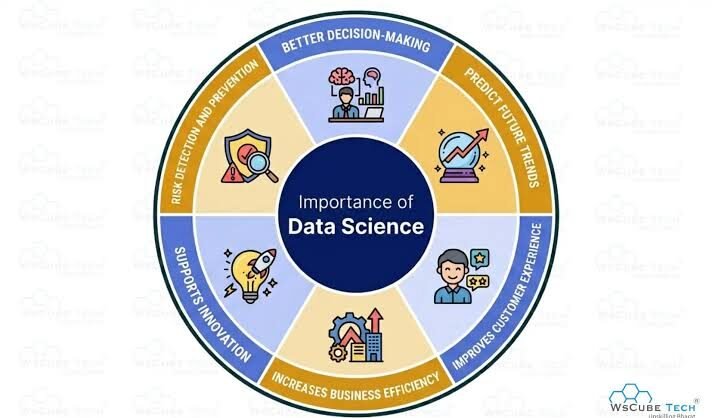
Data Science has become one of the most important fields in the modern digital world. Every day, businesses, websites, mobile applications, social media platforms, hospitals, banks, and governments generate enormous amounts of data. However, raw data by itself is not very useful. It needs to be collected, organized, analyzed, and interpreted before it can help people make better decisions. This is where Data Science comes into play.
In simple terms, Data Science is the process of using scientific methods, statistical techniques, programming, and analytical tools to understand data and discover useful information. It helps organizations identify patterns, predict future trends, solve problems, and make informed decisions.
What Is Data Science?
Data Science is an interdisciplinary field that combines mathematics, statistics, computer science, programming, and domain knowledge. Its main purpose is to extract meaningful insights from structured and unstructured data.
For example, an online store may collect information about what customers search for, what products they purchase, and how long they spend on different pages. A Data Science team can analyze this information to understand customer behavior. Based on the results, the company may recommend products that a particular customer is more likely to buy.
Data Science is not limited to businesses. It is also used in healthcare to support medical research, in finance to detect suspicious transactions, in transportation to improve routes, and in education to understand student performance.
Why Is Data Science Important?
The importance of Data Science has grown rapidly because organizations now have access to more information than ever before. Making decisions based only on assumptions can be risky. Data provides evidence that can help businesses and professionals make more accurate choices.
One major advantage of Data Science is improved decision-making. Instead of relying entirely on personal opinions, organizations can study historical information and current trends before taking action.
It can also help companies understand their customers. By analyzing customer data, businesses can discover what people want, which products are popular, and what factors influence purchasing decisions.
Another important benefit is efficiency. Data analysis can reveal unnecessary expenses, slow processes, and areas where resources are being wasted. Organizations can then make changes to improve productivity and reduce costs.
Data Science also plays an important role in prediction. While no analytical model can guarantee the future, historical data can help identify patterns that may provide useful forecasts.
How Does Data Science Work?
Data Science usually involves several stages. The process may vary depending on the project, but the basic steps remain similar.
The first step is data collection. Data can come from websites, databases, applications, surveys, sensors, social media platforms, or other sources.
The next step is data cleaning. Real-world data is often incomplete, duplicated, inconsistent, or incorrectly formatted. Data scientists clean the information so that it can be analyzed properly.
After cleaning, the data is explored. This stage is known as exploratory data analysis. Data scientists look for patterns, relationships, unusual values, and trends using statistics and visualization techniques.
The next stage may involve building a model. Depending on the problem, professionals can use statistical models or machine learning algorithms to make predictions or classifications.
Finally, the results are interpreted and communicated. A successful Data Science project is not only about creating a technically accurate model. The findings must also be understandable and useful to the people who need to make decisions.
Key Technologies Used in Data Science
Data Science uses many different technologies and tools. Programming languages are especially important because they allow professionals to manipulate data and develop analytical solutions.
Python is one of the most widely used programming languages in the field. It has a large ecosystem of libraries that make data analysis, visualization, and machine learning easier.
R is another popular language, particularly in statistics and academic research. It provides powerful tools for statistical analysis and data visualization.
SQL is also extremely important because much of the world’s business data is stored in relational databases. Data professionals often use SQL to retrieve, filter, and organize information.
Visualization tools are equally valuable. Charts, dashboards, and graphs can turn complicated datasets into information that is easier to understand. Tools such as Tableau and Power BI are commonly used for business analytics and reporting.
Machine learning is another major part of modern Data Science. Machine learning algorithms can identify patterns in data and use those patterns to make predictions or decisions.
Applications of Data Science
Data Science has applications across almost every major industry.
In healthcare, it can be used to analyze patient information, support medical research, improve hospital operations, and assist professionals in identifying potential health risks.
In banking and finance, Data Science can help detect fraudulent transactions, assess financial risks, analyze markets, and understand customer behavior.
Retail companies use data to manage inventory, personalize recommendations, understand customer preferences, and improve marketing strategies.
Transportation companies can analyze traffic patterns, optimize routes, estimate travel times, and improve logistics operations.
In entertainment, streaming services can study viewing behavior and recommend movies, shows, or music based on user preferences.
Sports organizations also use data to evaluate player performance, develop strategies, monitor fitness, and understand opponents.
These examples show that Data Science is not simply a technology used by software companies. It has become a practical tool for solving real-world problems.
Skills Needed for a Data Science Career
People who want to build a career in Data Science usually need a combination of technical and analytical skills.
A strong understanding of statistics is important because statistical concepts help professionals interpret data correctly. Programming skills are also valuable, particularly knowledge of Python, SQL, or R.
Machine learning is useful for projects that involve prediction, classification, or automated decision-making. Data visualization skills are also important because professionals often need to explain their findings to managers, clients, or other teams.
However, technical knowledge alone is not enough. Communication and problem-solving skills are equally important. A data scientist may create an excellent model, but if the results cannot be explained clearly, the model may not provide much practical value.
Domain knowledge can also make a significant difference. Understanding the industry or business problem helps data professionals choose the right questions and interpret results more effectively.
The Future of Data Science
The future of Data Science looks closely connected with artificial intelligence, automation, and the growing amount of digital information being produced around the world.
As organizations collect more data, they will need professionals who can transform that information into useful insights. At the same time, automated tools are making some parts of data analysis faster and easier.
Generative AI and advanced machine learning are also changing the way people work with data. These technologies can assist with coding, analysis, documentation, and other tasks. However, human judgment remains important for defining problems, evaluating results, checking data quality, and making responsible decisions.
Privacy and ethical data use will also become increasingly important. Organizations need to handle personal information carefully and ensure that analytical systems do not produce unfair or harmful outcomes.
The field is therefore likely to evolve rather than disappear. Professionals who continue learning new technologies while developing strong analytical and communication skills will be better prepared for future opportunities.
Frequently Asked Questions
1. What is Data Science in simple words?
Data Science is the process of analyzing data to discover useful information, patterns, and insights that can help people or organizations make better decisions.
2. Is Data Science difficult to learn?
Data Science can be challenging because it involves programming, statistics, mathematics, and analytical thinking. However, beginners can learn it gradually by starting with basic concepts and practicing regularly.
3. Which programming language is best for Data Science?
Python is one of the most popular choices because it is relatively easy to learn and has many libraries for data analysis, visualization, and machine learning. R and SQL are also widely used.
4. What does a data scientist do?
A data scientist collects and cleans data, analyzes information, identifies patterns, develops models, and communicates findings that can help solve business or technical problems.
5. Is mathematics required for Data Science?
Yes, mathematics and statistics are useful in Data Science. Beginners do not necessarily need advanced mathematics at the beginning, but a good understanding of statistics, probability, and basic mathematical concepts is valuable.
6. Where is Data Science used?
Data Science is used in many industries, including healthcare, finance, retail, education, transportation, technology, sports, marketing, and entertainment.
7. What is the difference between Data Science and Data Analytics?
Data Analytics generally focuses on examining existing data to understand what happened and why. Data Science has a broader scope and can also involve machine learning, predictive modeling, programming, and developing systems that work with data.
8. Does Data Science have a good future?
Yes. As organizations continue generating and collecting large amounts of information, the ability to analyze and use that data effectively remains important. The field is also evolving alongside artificial intelligence and machine learning.
Conclusion
Data Science has changed the way organizations understand information and make decisions. By combining statistics, programming, analytical methods, machine learning, and domain knowledge, it allows people to discover valuable insights hidden inside large datasets.
From healthcare and finance to retail, transportation, entertainment, and sports, its applications are widespread. As technology continues to advance, the demand for effective data analysis is likely to remain strong.
For anyone interested in technology, mathematics, business, or problem-solving, Data Science can be an exciting field to explore. It offers the opportunity to work with real-world problems and turn complex information into practical solutions.